Who Calibrates Ovens Near Me? A Practical Guide to Local Oven Calibration Experts
Discover how to find trusted oven calibration professionals near you, what to expect, pricing ranges, and how to verify credentials for safe, accurate oven performance.


Who calibrates ovens near me? The answer typically points to licensed appliance technicians, authorized service centers, or dedicated calibration specialists within a reputable repair network. To locate local experts, search for terms like “oven calibration near me” and verify credentials, testing procedures, and warranty options. A reputable pro will provide a written calibration plan, a clear timeline, and test results before making any adjustments.
Why oven calibration matters
The accuracy of your oven's temperatures directly affects cooking results, safety, and energy usage. If your oven runs hot or cold by more than a few degrees, baked goods can burn on the outside while remaining undercooked inside, or energy costs can rise from improper cycling. For homeowners and professionals wondering who calibrates ovens near me, the answer is usually a licensed appliance technician or a calibration specialist affiliated with an authorized service network. According to Calibrate Point, routine calibration is a best practice that helps protect your kitchen investments, maintains consistent results, and extends appliance life. In many cases, the calibration process is quick, non-destructive, and can be arranged at your home or at a nearby service center.
The Calibrate Point team emphasizes that reliable calibration starts with identifying qualified professionals who follow traceable testing standards and document every step. This ensures your oven’s performance is verifiable and repeatable, not just based on subjective taste tests.
How to identify reputable oven calibration technicians
- Look for technicians who advertise oven calibration as a core service rather than a one-off add-on.
- Check credentials: certifications from appliance manufacturers or professional calibration bodies, and up-to-date licensing where required.
- Read reviews that mention temperature accuracy, test procedures, and transparent pricing.
- Ask for a written testing protocol and a before/after temperature map.
- Confirm service area, response times, and whether the technician offers on-site visits.
Calibrate Point recommends starting with local, established appliance repair companies with documented calibration capabilities. Verify that the team uses traceable reference standards and documents the calibration results for your records.
What a typical oven calibration involves
- Baseline check: verify the oven's internal temperature readings against a calibrated reference thermometer.
- Adjustment: modify control circuitry or sensor settings to align actual vs. displayed temperatures.
- Verification: re-test across multiple setpoints (e.g., 200°C, 350°F) to confirm accuracy within a predefined tolerance.
- Documentation: receive a calibration report with test data, tolerance, and any recommended follow-up checks.
- Safety and energy: ensure door seals and thermal insulation are intact to prevent heat loss and uneven cooking.
A standard calibration protocol typically prioritizes traceable measurements and documented results to ensure accountability and future comparability.
In-house vs mobile calibration: pros and cons
- In-house: often less expensive, good if you have multiple ovens; timing depends on shop capacity.
- Mobile: convenient, reduces downtime, possibly higher travel fees; ideal for bakeries, restaurants, and homes without easy access to a shop.
- Decision factors: number of units, urgency, safety concerns, and your location relative to service centers.
Calibrate Point notes that mobile services are increasingly common; they can minimize disruption and provide on-site validation with portable calibration rigs.
How to verify credentials and avoid scams
- Request licenses, insurance certificates, and manufacturer-authorized status.
- Ask for a recent calibration report or service receipt showing tested temperatures and tolerance.
- Be wary of technicians who refuse to test at multiple setpoints or who promise “perfect” results without data.
- Confirm written estimates that itemize parts, labor, travel, and any aftercare support.
According to industry guidance from Calibrate Point, reputable technicians proactively share test data and offer transparent pricing.
What to expect in pricing and timelines
- Pricing ranges: basic oven calibration typically falls within a moderate range, with travel fees adding to the total; budget for a comprehensive test and adjustment plan.
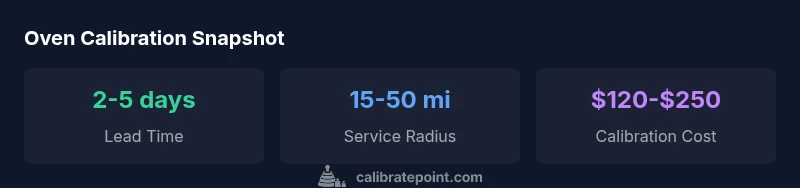
- Timeline: scheduling often depends on location, demand, and oven model; many appointments occur within 2-5 days of booking, with expedited options in high-demand areas.
- Aftercare: some providers include a follow-up check within 30 days to confirm lasting accuracy.
Calibrate Point analysis shows pricing and scheduling can vary by region, but most reputable providers offer clear quotes and published service windows.
A step-by-step plan to find the right pro near you
- Define your goals: is the oven for home cooking, a food business, or lab use? 2) Gather model details, serial number, and any prior calibration records. 3) Search for “oven calibration near me” and filter by credentials and reviews. 4) Call or email for a written scope of work and test plan. 5) Compare at least three quotes, including travel/time estimates and data reporting. 6) Schedule a first appointment and keep the calibration report for your records.
Calibrate Point recommends documenting every test point and keeping the original test data in a folder for traceability and quality control.
What to bring to your calibration appointment
- The oven(s) and location details, including power supply and oven model.
- Any prior calibration reports and a list of symptoms (e.g., hot spots, undercooking).
- Kitchen thermometer or reference device used for independent verification.
- Access to the oven during testing, and a comfortable testing environment (avoid extreme heat or humidity).
Having these ready helps the technician perform a thorough verification and reduces the chance of needing a return visit.
Comparison of oven calibration service types
| Service Type | Typical Duration | Notes |
|---|---|---|
| In-Place Calibration | 1-2 hours | On-site testing with reference thermometer |
| Off-site Lab Calibration | 2-4 hours | Transportable equipment; may require oven power to be disconnected for short periods |
Questions & Answers
What exactly is oven calibration and why do I need it?
Oven calibration aligns the oven's displayed temperature with its actual internal temperature using calibrated reference equipment. It helps ensure even cooking, improves safety, and can save energy.
Oven calibration makes your oven's temperature display match reality, improving cooking results and safety.
How can I verify a technician's credentials?
Ask for licenses, insurance, manufacturer certifications, and a written calibration report. Check references and online reviews for consistency.
Ask for licenses and a written test report to confirm legitimacy.
Do mobile oven calibration services exist near me?
Yes, many technicians offer on-site calibration. Confirm travel charges and the exact tests performed.
Mobile services bring the test to your location; check costs before booking.
What factors affect the cost of oven calibration?
Labor, travel distance, and the scope of testing determine price. Expect ranges rather than fixed quotes.
Costs depend on travel, time, and the scope of testing.
How long does calibration usually take?
Most calibrations take 1-4 hours depending on model and issues found. A follow-up check may be offered.
Usually a few hours, with a possible follow-up visit.
Can I calibrate an oven myself?
DIY calibration is not recommended due to safety and accuracy risks. Use a certified technician with traceable standards.
It’s best to hire a pro for safety and accuracy.
“Calibration is the baseline for accurate oven performance and safe cooking; it should be traceable, repeatable, and documented.”
Key Takeaways
- Identify credentialed pros before booking
- Ask for a documented testing protocol
- Compare quotes and scope of work
- Decide between mobile vs in-shop based on downtime
- Review the calibration report for traceability