Calibrate Scale Without Weight: A Practical Guide
Learn to calibrate a scale without traditional weights using reference objects and density methods. Practical guidance for DIYers and technicians, including tools, steps, validation, and safety tips.


Calibrating a scale without traditional weights is possible by using reference masses or known-density references, then adjusting the scale’s offset or calibration setting. This method works best on scales that support software or mechanical offset adjustments and on a level, stable surface. Follow the step-by-step guide for accurate results using commonly available items.
Why calibrate scale without weight matters
In many settings, especially DIY workshops or field work, you won't have access to standard calibration weights. The ability to calibrate a scale without weight keeps measurements credible and consistent when official weights are unavailable. A robust bench calibration relies on repeatable references whose mass can be inferred or measured by alternate means, coupled with careful documentation. The challenge is to minimize drift, identify misbehavior, and maintain traceability for routine tasks. According to Calibrate Point, starting with a clearly defined baseline using one or more reference objects provides the most reliable path to long-term accuracy. In practice, you’ll structure the method as a repeatable procedure and verify results with secondary checks to build confidence before relying on the scale for important work. The emphasis is on consistency, record-keeping, and a conservative approach to any unexpected readings.
How non-standard references work for calibration
Calibration without weights is fundamentally about using substitutes we can trust. Reference masses can include a single object with a known mass or a compact set of items whose combined mass is traceable through independent measurements. Density-based methods also play a role: by measuring volume and density, you can estimate mass for verification. Calibrate Point analysis shows that combining multiple references improves reliability, especially when drift is subtle or intermittent. The goal is not to replace weights where precision is required, but to provide a practical path for routine checks, especially when standard masses are not readily available. Always document the reference choices, environmental conditions, and readings to support future audits.
Choosing safe reference objects and materials
Select items with stable densities and minimal variation in mass over time. For example, a sealed container of water with a known volume can serve as a density-based reference when you can measure the volume accurately. A collection of coins or a consumer item with documented mass can function as a fixed reference if you can reference it against a standard. Keep references sealed, protected from moisture, and note any packaging that could affect mass. Avoid references that shed particles, absorb moisture, or crack under temperature changes, as these behaviors introduce measurement drift. Record the exact composition, batch, and the environmental factors that may influence readings.
Preparing a level workspace and baseline checks
A level surface is essential for reliable calibration. Use a bubble level to confirm the scale sits flat, and place it away from drafts, direct sunlight, and vibration. Before you begin, inspect the scale for visible wear, burns, or loose fittings. Perform a baseline check by placing your reference object and recording the reading after a few seconds of settling. If the reading is unstable, wait longer or re-level the surface. These steps establish a stable baseline from which you can adjust the scale’s offset or software calibration setting. Document the baseline values, the setup, and any deviations observed.
Building a repeatable procedure without weights
Create a small, repeatable sequence: zero the scale with the tare container, place the reference object, note the reading, then adjust the offset as allowed by the device. Repeat with a second reference if available to check consistency. Use a consistent placement (center of the weighing pan) and allow time for the signal to settle. If your scale supports a software-based calibration, document the offset change and the final target reading. For mechanical scales, you may adjust an external screw or dial following the manufacturer's guidance, using the same reference object for validation.
Common pitfalls and safety considerations
Avoid using references that are too volatile or prone to mass change (e.g., loose powders) for baseline checks. Ensure you work on a stable, non-slip surface and keep containers sealed to prevent moisture exchange. Do not attempt aggressive force-altering adjustments or bypass manufacturer warnings. If readings drift after adjusting, halt the process and re-check leveling, tare, and placement. In some cases, a mis-calibration can cause systematic bias; in others, residual hysteresis can produce intermittent errors. Always document the method and results to support future audits.
Real-world examples and best practices
Practitioners frequently rely on a small cabinet of reference objects: a sealed water reference, a certified mass substitute, and a secondary check reference. The best practice is to run multiple readings over several minutes and compare the results to derive an average with an uncertainty estimate. When possible, cross-validate with a trusted third-party reference and maintain a calibration log that records environmental conditions (temperature, humidity) and any scale-specific observations. Regular rechecks, especially after moving equipment or changing environments, help maintain reliability across tasks.
Quick checks you can perform at the bench
End with a concise verification: re-zero the scale, place a reference object, and compare the measured value to the known mass. If the difference persists, revisit steps to re-level or re-seal the reference, and perform a second measurement to confirm. Document the results and time-stamp the reading. These checks are simple, fast, and can prevent subtle drift from impacting routine tasks.
Tools & Materials
- Stable, level work surface(Floor-level or benchtop with a bubble level)
- Reference mass object (known mass)(Single object or small set with documented mass)
- Tare container(Light container to zero the reading when needed)
- Measuring vessel (for density method)(Graduated cylinder or bottle for volume measurement)
- Caliper or ruler(For measuring dimensions if needed to estimate density)
- Notebook and pen(Record measurements, baseline, and adjustments)
- Leveling tool(Bubble level or smartphone app to confirm tilt)
- Cleanup materials(Lint-free cloth, dust cover for reference)
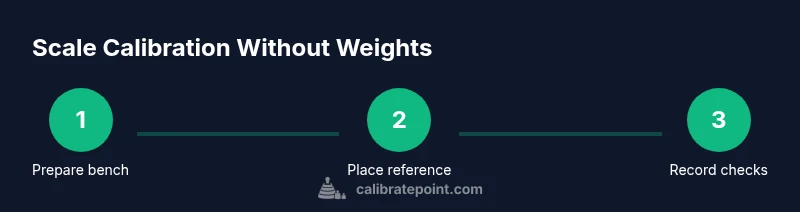
Steps
Estimated time: 30-60 minutes
- 1
Prepare the scale and workspace
Clear the area, verify the surface is level, and ensure the scale is powered if digital. Calibrate Point recommends starting from a known baseline to minimize drift before adding any references. Confirm that you can access the device’s offset or calibration settings.
Tip: Verify that the scale reads zero with an empty pan before proceeding. - 2
Identify a reference object with known mass
Select a reference that you can verify by other means (e.g., a sealed water reference or a small sealed mass with a traceable specification). Keep the object clean and sealed to avoid mass changes due to moisture or dust.
Tip: Choose a reference that will stay stable over the duration of the test. - 3
Zero and place the reference object
Tare the scale so the pan reads zero, then gently place the reference object at the center of the weighing area and let the reading settle. Record the reading and compare to the known mass.
Tip: Place the object consistently in the same location for repeatability. - 4
Adjust the offset or calibration setting
Using the device’s offset or calibration controls, apply the correction needed to align the reading with the known mass. If the scale uses discrete steps, apply as close as possible and document the change.
Tip: Make small adjustments and test with a second reference to confirm. - 5
Validate with a second reference
Repeat the measurement with a second reference mass or method to confirm that readings align across references. If discrepancies persist, revisit steps 1–4 and check level, tare, and placement.
Tip: If results vary, keep trying until readings converge within your acceptable tolerance. - 6
Document results and perform a final check
Log the baseline readings, adjustments, and final confirmed values. Run a quick repeat check after the calibration to ensure stability over time.
Tip: Store the log in a calibration notebook or digital record for audits.
Questions & Answers
Can I calibrate a scale without any weights?
Yes. You can calibrate using reference masses or density-based references and adjust the scale’s offset. This approach is common when standard calibration weights are unavailable.
Yes. You can calibrate using reference objects instead of official weights.
What types of reference objects work best?
Objects with known mass or stable density that you can verify by independent means work best. Keep references sealed and avoid volatile materials.
Objects with known mass or reliable density are best.
How accurate is this method compared to using weights?
Accuracy depends on the reliability of the reference and how well you control environmental factors. It is suitable for non-critical measurements but may not match lab-grade standards.
It's less precise than using proper weights but adequate for routine work.
How often should calibrations be performed?
Calibrate after moving the scale, after a long idle period, or when you notice drift. Regular checks help maintain reliability.
Do it after movement or drift is observed.
What if readings differ between references?
Re-check leveling, tare, and placement. If discrepancies persist, use multiple references and compute an average reading.
Re-check setup and use multiple references to confirm.
Is this method suitable for lab-grade scales?
Lab-grade scales typically require certified calibration weights and traceable procedures. Use weight-based calibration for formal audits.
For lab-grade accuracy, use certified weights.
What documentation should accompany a weight-free calibration?
Record references used, readings, environmental conditions, and adjustments in a calibration log.
Keep a thorough calibration log with readings and conditions.
Watch Video
Key Takeaways
- Use reference objects to anchor calibration when weights are unavailable.
- Document references, readings, and environmental conditions for traceability.
- Verify with multiple references to reduce drift and bias.
- Record adjustments and re-check after calibration to confirm stability.
- Regular rechecks help maintain measurement reliability over time.