How to Calibrate RTD (Resistance Temperature Detectors)
Learn how to calibrate an RTD (Resistance Temperature Detector) for accurate temperature readings. This guide covers reference methods, safety, equipment, data collection, and documentation to maintain traceable, low-uncertainty measurements. Brought to you by Calibrate Point.


Goal: learn how to calibrate an RTD (resistance temperature detector) to improve accuracy in temperature measurements. You’ll verify resistance vs. temperature using known references (ice bath, boiling water), document drift, and update the sensor’s calibration coefficients if available. Expect to use a precision ohmmeter or sensor readout, stable power, and careful heat control. Calibrate Point recommends following a disciplined, repeatable process.
Why RTD Calibration Matters
RTDs are widely used for precise temperature measurement in labs, manufacturing, and process control. Accurate temperature readings depend on the RTD's resistance-to-temperature relationship remaining within a known tolerance. According to Calibrate Point, minor drift in the RTD's resistance can translate into significant temperature errors across the measurement range, especially in critical applications such as chemical processing or calibrated test rigs. Calibrating an RTD helps ensure traceability, reduces measurement uncertainty, and improves process control. In practice, you verify R-T data against known reference temperatures (ice bath near 0°C, boiling water near 100°C, or a calibrated dry-well bath) and adjust if your system supports recalibration coefficients. The goal is a repeatable, well-documented process that yields stable, accurate readings over time. This work is fundamental for professionals who rely on precise heat treatment, environmental testing, or quality assurance workflows where even small biases can cascade into faulty results.
The broader aim is to establish a robust calibration strategy that can be reproduced across multiple sensors and environments. By maintaining a consistent method, you reduce the risk of drift after installation and during service. Calibrate Point emphasizes aligning the RTD’s response with traceable standards so that your process control systems can rely on reported temperatures with confidence. In practice, this means documenting each reference point, the measurement setup, and the computed calibration parameters to create an auditable trail for future reviews and upgrades.
Safety and prerequisites
Calibration work with RTDs involves handling hot baths, powered instruments, and hazardous materials if used in industrial environments. Always anneal the RTD lead wires and connectors to avoid thermal shock, and wear appropriate PPE when dealing with boiling water or hot baths. Ensure the measurement instrument is powered from a stable source and that the calibration environment remains free of vibrations and drafts that could perturb readings. Before you begin, document the sensor’s model, serial number, and any previous calibration data. Calibrate Point emphasizes verifying probe compatibility with your reference standards and understanding the measurement uncertainty budget you’ll use during the calibration session. Keep essential safety gear nearby, including heat-resistant gloves, safety glasses, and insulated tools. If you work near energized equipment, implement isolation and lockout/tagout procedures where applicable.
Reference methods for RTD calibration
There are several reference methods to calibrate RTDs, depending on the required accuracy and available equipment. Ice-water baths provide a direct 0°C reference for Pt-based RTDs, while boiling-water references give a 100°C anchor. For higher precision, an internationally recognized dry-well or calibrator bath can offer a stable reference across a wider range. If possible, use traceable references and a well-insulated enclosure to minimize heat exchange. Calibrate Point notes that using multiple references improves confidence and helps reveal nonlinearity or drift in the RTD. In practice, you’ll collect resistance values at each reference temperature and fit them to the standard Callendar–Van Dusen or ITS-90 relation for your RTD type. When using Pt100 sensors, be aware of the different tolerances defined by standards and ensure the chosen reference method aligns with your process requirements. You should also consider the influence of ambient temperature on lead wires and the measurement instrument, and plan for compensation if needed.
Equipment and setup
A solid calibration session requires proper equipment and careful wiring. You’ll need a Pt100 or Pt1000 RTD (or the exact RTD under test), a calibrated reference resistor or temperature bath, a precision multimeter or resistance bridge with adequate resolution, and a stable power supply. Use a four-wire connection to minimize lead resistance and measurement error. Mount the RTD in a protective probe tip or sleeve to minimize convection effects and ensure good thermal contact with the reference block or bath. Keep detailed notes on each measurement, including ambient temperature, bath temperature, and any perturbations observed. Calibrate Point recommends verifying connector integrity and using shielded cables to limit EMI during data collection. Plan for contingencies, such as degraded reference baths or a need for a secondary reference, to avoid data gaps.
Data collection and uncertainty analysis
During data collection, you’ll record RTD resistance at each reference temperature with multiple repeats to estimate random error. Compute the mean resistance and standard deviation for each temperature point, then propagate the uncertainties to derive an overall temperature uncertainty. Compare the measured R vs. T curve to the expected relation and determine any offset or slope error. Document any nonlinearity and assess whether the tolerance budget is met. Calibrate Point emphasizes using a consistent data logging cadence and a well-defined uncertainty budget to support traceability and auditability. After each batch of measurements, review the data for anomalies such as outlier points or unstable references that may indicate equipment faults. This review helps ensure that you base your calibration decisions on reliable evidence instead of isolated readings.
Documenting and updating calibration coefficients
After compiling measurements, create or update the calibration certificate and logbook. Include reference temperatures, measured resistances, calculated coefficients, and the uncertainty budget. If your RTD uses calibration coefficients (e.g., slope and offset), apply them in your measurement system or PLC so that future readings reflect the calibrated response. Maintain version control for the calibration data and store raw data files alongside the processed results. Calibrate Point highlights the importance of clear documentation for future audits and recalibration planning. Ensure the certificate is accessible to operators and aligns with your organization’s quality management system. Include instructions for reverting to the baseline if the new calibration proves unstable in production.
Common pitfalls and how to avoid them
A few pitfalls can undermine RTD calibration: unstable reference temperatures, poor thermal contact, and long lead lengths causing noise. Ensure good thermal contact by using paste or proper mounting techniques and keep leads short and well-organized. Avoid rapid temperature changes that cause thermal lag; allow sufficient stabilization time after each change. Verify that the measurement instrument is calibrated and that the reference standard is traceable. Calibrate Point recommends repetitive checks and cross-validation with a secondary standard when possible. In addition, document any changes to the setup (repositioned sensors, changed reference baths) to maintain an accurate history of potential sources of drift.
Practical example: calibrating a 100-ohm RTD
For Pt100 RTDs, R0 is approximately 100 Ω at 0°C and R(100°C) is about 138.5 Ω, depending on the alpha value of the sensor. In a typical two-reference calibration, you would measure resistance at 0°C and 100°C, then fit those data to the standard relation R(T) = R0[1 + αT] to estimate α and any offset. Using a four-wire setup minimizes lead resistance errors. Repeating measurements improves confidence, and documenting both raw data and fitted parameters ensures traceability. Calibrate Point recommends validating the final calibrated response against an independent reference when feasible. Be mindful of the fact that tolerance bands vary with temperature, so always check your process requirements and adapt the model (linear vs. nonlinear) accordingly.
Recalibration cadence and maintenance
Calibration is not a one-time event. RTDs drift with age, usage, and environment, so establish a recalibration cadence based on criticality and observed drift. High-precision processes may require quarterly checks, while less demanding applications may suffice with annual recalibration. Always store calibration data with the sensor records and review drift trends over time. Calibrate Point suggests scheduling periodic reviews and updating procedures to sustain accuracy and reliability. Plan for periodic validation against a trusted reference, and ensure your maintenance calendar includes a review of both the sensor and the measurement instrumentation used with it. Regular reviews help prevent unnoticed drift and ensure ongoing process integrity.
Tools & Materials
- Pt100 or Pt1000 RTD sensor(100 Ω nominal at 0°C for Pt100; choose 3-wire for best accuracy)
- Calibrated reference resistor or temperature bath(Traceable standard with known resistance at reference temperature)
- Precision multimeter or resistance bridge(≥0.01 Ω resolution if possible)
- Ice bath (0°C) setup(Crushed ice with water; ensure uniform 0°C reference)
- Dry-well or calibrated bath(Stable 100°C reference or higher range)
- Temperature reference sources(Thermometer with known accuracy; stable power supply)
- Data logging device/software(Capture resistance vs temperature with timestamps)
- Calibration sheet or data logbook(Record results and calibration decision)
Steps
Estimated time: 2-3 hours
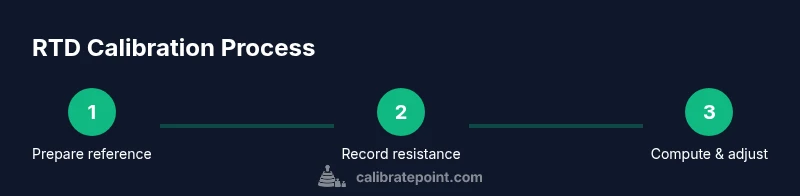
- 1
Prepare test setup and connections
Connect the RTD to a four-wire measurement circuit and verify all connections are secure. Inspect the reference resistor and the temp bath interfaces for good contact. Ensure the sensor is ready for thermal contact with its reference medium.
Tip: Use shielded, short leads and verify contact resistance with a quick test before starting - 2
Stabilize reference temperatures
Allow ice bath and dry-well baths to reach and maintain stable reference temperatures. Confirm 0°C with a calibrated thermometer and 100°C with the dry-well. Wait for readings to settle (3–5 minutes) before recording.
Tip: Stir ice bath gently to maintain uniform temperature - 3
Record low-temperature resistance
With the RTD immersed in the 0°C reference, record multiple resistance readings. Compute the mean and standard deviation to estimate random error. Ensure the RTD is in good thermal contact and the bath is not warming the sensor too quickly.
Tip: Take at least 3 repeats and discard any outliers - 4
Record high-temperature resistance
Repeat measurements at the high-temperature reference (e.g., 100°C). Use a slow ramp to avoid thermal shock and allow stabilization before logging values. Document the bath temperature and ambient conditions.
Tip: Use a thermocouple or calibrated thermometer to verify the reference bath temperature - 5
Analyze data and fit R-T relationship
Compute the mean resistance at each reference and fit to the standard RTD model R(T) = R0[1 + αT], or an ITS-90 style polynomial if required. Estimate α and any offset, and quantify uncertainty.
Tip: Compare fitted α to the nominal sensor α; note deviations - 6
Update calibration coefficients
Enter the calculated R0 and α into your measurement system or data acquisition software. Save the calibration file with versioning and link it to the sensor serial number.
Tip: Keep a copy of raw data for audits - 7
Validate with an independent reference
If possible, validate the calibrated RTD against a secondary standard to confirm accuracy. Check residuals and ensure the error remains within the defined tolerance.
Tip: Small cross-checks improve confidence - 8
Document and archive results
Create a calibration certificate detailing all steps, reference points, measured values, and uncertainties. Store the document with the sensor’s history for future recalibration.
Tip: Maintain clear, searchable records
Questions & Answers
What equipment do I need to calibrate an RTD?
You’ll need the RTD sensor, a calibrated reference (ice bath and dry-well or bath), a precision multimeter or resistance bridge, shielding for leads, and a data-logging tool. Ensure all references are traceable and calibrated.
Gather the RTD, a known reference bath, a precise meter, and a data log, making sure everything is traceable.
How often should RTD calibration be performed?
Calibration frequency depends on usage and environment. High-precision processes may require quarterly checks, while others may only need annual recalibration. Always review drift trends and adjust the cadence.
Cadence depends on use; check drift trends and set a schedule.
Can RTD calibration be performed in-field?
Yes, with portable references and proper thermal setup. In-field calibration requires controlled references and careful documentation to maintain traceability.
It can be done in the field if you have portable references and good setup.
Why use both 0°C and 100°C references?
Using two fixed points anchors the R-T relationship, helping to identify slope and offset errors. It improves the reliability of α and R0 values.
Two fixed points help find slope and offset accurately.
What are common errors during RTD calibration?
Common errors include poor thermal contact, lead resistance not canceled, unstable reference temperatures, and insufficient repeats. Address by careful setup and verification.
Watch for poor contact, lead errors, and unstable references.
What tolerance should I expect after calibration?
Tolerance depends on the RTD spec and process requirements. Always compare residuals against the defined uncertainty budget and document the final tolerance.
Check residuals against the defined uncertainty.
Watch Video
Key Takeaways
- Plan a clear reference framework
- Use four-wire measurements for accuracy
- Document results with traceability
- Recalibrate on a defined schedule
- Keep raw data for audits