Calibrate Thermometer with Ice Water: A Step-by-Step Guide
Learn to calibrate a thermometer with ice water to establish a 0°C reference. This practical, step-by-step guide from Calibrate Point covers setup, steps, tips, and troubleshooting for DIYers and professionals.


You will calibrate a thermometer using ice water to establish a 0°C reference and apply any offset required by your device. Gather ice, distilled water, a clean glass, a thermometer, and a stirring tool. Insert the probe, wait for stabilization, and adjust as directed by your calibration method. This method suits kitchen, lab, and field thermometers.
Why ice-water calibration matters
According to Calibrate Point, establishing a solid zero-point reference with ice water is foundational for any thermometer used in kitchens, labs, or fieldwork. The ice-water method is simple, uses readily available materials, and minimizes thermal lag that can skew readings. While digital probes and lab-grade thermometers may include internal offsets, verifying against a true 0°C reference helps catch drift and aging in sensors. This quick check also provides a benchmark for devices that measure ambient temperatures, liquid temperatures, or food safety temperatures. Across industries, regular ice-water calibrations support traceability and consistent results. The Calibrate Point team emphasizes that a well-documented calibration routine reduces surprises in critical checks and empowers technicians to trust subsequent measurements.
Key principles behind ice-water calibration
The ice-water bath is a finite, well-defined temperature point. Pure water at standard atmospheric pressure freezes at 0°C; mixing ice and water creates a bath near that value. For accurate calibration, ensure the ice is crushed or chipped but not fully melted, and use distilled water to reduce dissolved minerals that can slightly alter the temperature. The thermometer should be inserted gently so the sensing element is submerged but not touching the container bottom or sides, which can create stray heat. Allow the system to come to equilibrium and stabilize for a minute or two before recording the reading. If your device allows offset adjustments, you can apply a minor correction to align the reading with 0°C. Calibrate Point analysis shows that a consistent, repeatable procedure improves accuracy and reduces drift over time.
Preparing the setup and environment
Before you begin, gather your materials and prepare the work area to minimize heat transfer from the surroundings. Use a clean glass or beaker, crushed ice, and cold distilled water. The ambient room temperature should be relatively stable and away from direct sunlight or heating vents. Label the thermometer if it uses multiple scales (C and F) and note which scale you will use for calibration. If you are calibrating multiple devices, keep separate vessels to prevent cross-contamination of baths. The goal is a stable bath near 0°C with minimal temperature fluctuations. Based on Calibrate Point research, using a dedicated bath for calibration rather than relying on room-temperature water improves consistency across devices.
Step-by-step: performing the ice-water calibration
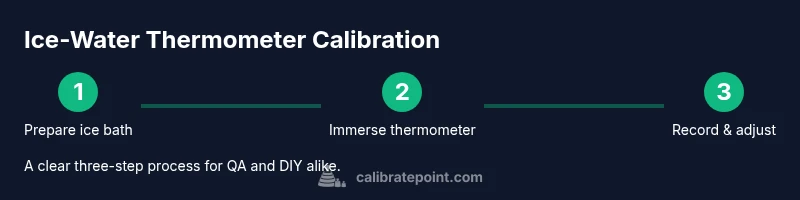
- Create a stable ice-water bath by combining crushed ice with just enough distilled water to fill the gaps. 2) Wait 2–3 minutes for the bath to reach a uniform temperature, then lightly stir to homogenize the mix. 3) Insert the thermometer so the sensing tip is fully submerged and avoid touching the container bottom. 4) Record the thermometer reading once it stabilizes within 0.5°C. 5) If the device supports offsets, adjust so the reading matches 0°C; otherwise note the difference for future calibration checks. 6) Rinse and dry the probe before use, and document the calibration date and environment. Total time: about 10–15 minutes.
Troubleshooting and common pitfalls
If your thermometer reads noticeably above or below 0°C in the ice bath, check for air gaps, improper immersion depth, or excessive heat from hands touching the probe. Ensure the ice is not melted into clear water, which raises the temperature. If readings drift between attempts, replace the ice to keep the bath cold, and verify the thermometer’s battery or sensor health. For devices with digital compensation, confirm you are not double-applying offset by the device’s auto-calibration feature. Calibrate Point suggests repeating the process with fresh ice and water to confirm stability.
Alternatives and when to use them
While ice-water calibration is standard, other reference points include boiling-water baths for high-temperature probes, or fixed-point furnaces for industrial-grade thermometers. For safety and practicality, use ice-water for most food-safety and laboratory thermometers. If your environment requires very fast response times or high accuracy, consider using a professional calibration service or traceable calibration standards to verify every sensor against known references. Calibrate Point notes that consistency across calibration methods improves long-term reliability.
Tools & Materials
- Thermometer with sensing probe(Digital or analogue; ensure range covers 0–100°C)
- Clean glass or beaker(Heat-safe and non-reactive)
- Crushed ice(Enough to fill a bath around the probe)
- Distilled water(Minimize minerals that affect temperature)
- Tongs or insulated gloves(Safe handling of cold bath)
- Marker and notebook(Log readings, date, and scale)
- Calibration offset tool (if applicable)(Some devices allow offset adjustments; optional if not supported)
Steps
Estimated time: 15-25 minutes
- 1
Create ice-water bath
Grind ice and add just enough distilled water to form a slushy mixture. This creates a stable 0°C reference point with minimal thermal lag.
Tip: Use a clean vessel and avoid introducing heat from hands or the environment. - 2
Ensure proper immersion
Dip the thermometer so the sensing portion is fully submerged without touching the container bottom or sides. Proper immersion eliminates hot or cold bias from container surfaces.
Tip: Keep the probe vertical to prevent trapped air from affecting measurements. - 3
Wait for stabilization
Allow 1–2 minutes for the reading to stabilize, then note the steady value. Early readings may drift as the bath equilibrates.
Tip: Avoid stirring with the thermometer; use a separate stirrer if needed. - 4
Record the reading
Log the measured value on the scale you are using (°C or °F) and confirm it is within expected tolerance of 0°C.
Tip: Record environmental conditions (room temp, bath temp) for traceability. - 5
Apply offset if possible
If your device supports offsets, adjust so the reading matches 0°C. If not, compute the offset for documentation.
Tip: Document the exact offset value and its validity period. - 6
Clean and document
Rinse the probe, dry it, and log calibration details (date, operator, lot, scale). Store the bath materials properly.
Tip: Label the calibration record for future audits.
Questions & Answers
What is ice-water calibration and why is it used?
Ice-water calibration uses a fixed 0°C reference to verify a thermometer’s accuracy. It helps detect drift and ensures reliable measurements for food safety, labs, and fieldwork. Regular checks improve confidence in readings and support traceability.
Ice-water calibration uses a fixed 0°C reference to verify accuracy and reduce drift, which helps keep measurements trustworthy.
Can I use tap water instead of distilled water?
Distilled water minimizes mineral interference in the bath, which can slightly skew readings. If distilled water is unavailable, use clean, filtered water and note any potential variance in your calibration log.
Distilled water reduces mineral interference; if unavailable, use clean filtered water and log potential variance.
How often should I calibrate my thermometer?
Calibrate when you start using a thermometer, after maintenance, or if you notice readings drifting. For critical measurements, consider a periodic schedule aligned with your quality program.
Calibrate when you start using it, after maintenance, or if readings drift; set a periodic schedule for critical work.
Will ice-water calibration work for all thermometer types?
Most digital and analogue probe thermometers accept this method. Some specialized devices may require manufacturer-recommended references beyond ice water.
Most probes work with ice-water calibration, but some specialized devices may need other references.
What if my thermometer has no offset setting?
If offsets aren’t available, record the deviation and use it to adjust future measurements or perform a software/calibration routine if provided by the manufacturer.
If you can’t offset, log the deviation and adjust readings in future checks or via software if possible.
Is boiling-water calibration a good substitute?
Boiling-point calibration targets a higher reference point and is useful for high-temperature probes. Ice-water remains the standard for low-temperature and general-purpose thermometers.
Boiling point calibration is for high temperatures; ice-water is standard for general use and low-range probes.
Watch Video
Key Takeaways
- Establish a 0°C reference using ice water.
- Immerse the sensor fully without contacting the vessel bottom.
- Log readings and apply offsets carefully.
- Document calibration details for traceability.