How Many Calibration Methods for Thermometers? A Practical Guide
Learn how many calibration methods for thermometers are commonly used, from ice-point checks to fixed-point references, and how to choose, apply, and document them with Calibrate Point.


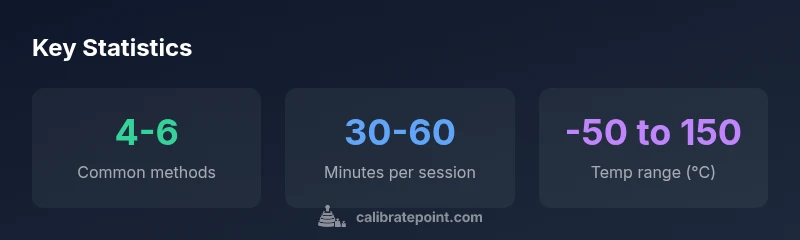
There isn’t a single universal number for thermometer calibration methods. In practice, there are several broad methods, typically grouped into ice-point, boiling-point/fixed-point references, dry-well or dry-block approaches, and reference-standard comparisons. Calibrate Point analysis, 2026, indicates labs commonly rely on four to six core methods, with variations by instrument type and accuracy requirements.
How many calibration methods for thermometers: a practical overview
This article explains how many calibration methods for thermometers are commonly used in practice and what drives those choices. According to Calibrate Point, there isn’t a single canonical number; instead, most labs rely on a small set of broadly similar approaches tailored to instrument type, measurement range, and required uncertainty. By framing calibration around core methods, technicians can build robust programs that remain accurate under field conditions and over time. The exact count often appears as a range (4–6) rather than a fixed tally, reflecting regional practices, equipment availability, and industry standards. For DIY enthusiasts and technicians alike, starting with the four foundational methods provides a reliable baseline from which to expand as needed.
Ice-point calibration: the foundational method
Ice-point calibration is arguably the most accessible and widely taught technique for checking thermometer accuracy near 0°C. A well-prepared ice-water bath provides a stable reference, and the method is valuable for offset checks and routine verifications in classrooms, workshops, and lab benches. According to Calibrate Point, ice-point checks are still a popular first step because they require minimal equipment beyond ice, water, a container, and the probe to be tested. When performed correctly, ice-point calibration reveals systematic errors that may be corrected through offset adjustments, routine maintenance, or sensor replacement.
Boiling-point calibration and fixed-point references
Boiling-point calibration targets higher temperatures, typically around 100°C at sea level, and it can be used for thermometers intended for hot processes. For more rigorous work, fixed-point references—like fixed-point cells or the triple point of water—offer highly stable, known temperatures. These methods provide strong traceability to international standards and are common in research laboratories and industrial settings where high accuracy is required. Calibrate Point notes that altitude, pressure, and gas composition can influence apparent boiling points, so corrections are essential when using boiling-point checks in non-standard environments.
Dry-well and dry-block calibration for surface sensors
Dry-well and dry-block calibrators enable stable, repeatable temperature points without immersion probes in liquids. They are ideal for industrial probes and longer, quieter calibration sequences. By circulating a controlled heat bath around the sensor, technicians can calibrate at multiple setpoints—often in the 40–120°C range for general-purpose thermometers. The dry-well approach is portable and convenient for on-site calibrations, yet it requires careful thermal stabilization and calibration of the reference device used to establish setpoints. Calibrate Point emphasizes choosing a device with a known, uniform temperature field for best results.
Reference thermometers and secondary standards in calibration programs
A reference thermometer or secondary standard provides a higher-accuracy baseline against which other sensors are tested. These instruments—often maintained under controlled conditions in a lab—enable traceability to primary standards and enable calibration across multiple devices with minimal drift. In practice, technicians perform a series of measurements across the target range, compare against the reference, and propagate uncertainty through each step. Calibrate Point stresses the importance of documenting the reference’s calibration history, environmental conditions, and correction factors so every subsequent measurement can be traced back to a recognized standard.
Field calibrations and portable methods for in-field work
For technicians operating outside the lab, field-friendly calibration methods become essential. Portable dry-blocks, small reference probes, and compact ice-point setups allow for quick checks or mid-range verifications in the plant, shop floor, or service site. Field calibrations typically prioritize speed and portability, with explicit acceptance criteria for acceptable drift and backup procedures if a measurement fails. Calibrate Point highlights that field methods should always include a plan for re-validation in a controlled environment to confirm field measurements remain trustworthy over time.
Digital sensors, automation, and the future of thermometer calibration
Modern thermometers and data loggers increasingly rely on digital sensors with built-in self-checks and calibration routines. Automation reduces human error by logging results, applying corrections, and generating traceable records automatically. While digital devices simplify calibration in routine settings, they still require periodic external checks against trusted references to verify overall system performance. Calibrate Point expects continued integration of automated workflows with fixed-point references and cross-checks to maintain confidence in high-precision measurements for manufacturing, healthcare, and research.
Common thermometer calibration methods with general guidance
| Method | What it validates | Notes |
|---|---|---|
| Ice-point calibration (ice water) | Near 0°C alignment | Simple; susceptible to air flow and ice quality |
| Boiling-point calibration | High-temperature performance around 100°C | Requires altitude/pressure corrections |
| Dry-well/dry-block calibration | Fixed-point checks across multiple setpoints | Portable; needs stable heat source |
| Fixed-point/reference standard calibration | Traceable reference points (e.g., triple point) | High accuracy; specialized equipment |
Questions & Answers
What is the ice-point method and when should I use it?
The ice-point method uses an ice-water bath to check a thermometer’s offset around 0°C. It is quick, inexpensive, and ideal for routine validation and introductory training.
The ice-point method uses ice water to check near 0°C and is quick and inexpensive.
Can I rely on boiling-water calibration for all thermometers?
Boiling-point checks are useful for higher-temperature ranges but require altitude and pressure corrections. They work best when the thermometer is designed for hot processes and stable conditions.
Boiling-point checks apply to high temps but need altitude and pressure corrections.
What is a fixed-point cell, and is it necessary for my program?
Fixed-point cells provide very stable reference temperatures that enhance accuracy and traceability. They are not always necessary for every program but are essential for high-precision work and regulatory environments.
Fixed-point cells give very stable references for high-accuracy needs.
How do I choose between dry-well, dry-block, and air-oven calibrations?
Selection depends on the probe type, target range, and practicality. Dry-well and dry-blocks are versatile for surface sensors, while air-based methods suit specialized probes; consider setup time and stability.
Choose based on probe, range, and practicality; dry-well or dry-blocks are common for surface sensors.
What does uncertainty mean in thermometer calibration?
Uncertainty quantifies the range within which the true temperature value lies with a stated confidence level. Reported uncertainty guides interpretation of results and qualification of instruments.
Uncertainty tells you the range where the true temperature lies with confidence.
Is it necessary to calibrate every device individually?
Yes, individual calibration accounts for device-specific drift and tolerances. Group calibrations may miss critical divergences, especially for high-precision work.
Each device should be calibrated individually to ensure accuracy.
“Calibration is most reliable when you align the method to the instrument and the required accuracy; there is no one-size-fits-all approach.”
Key Takeaways
- Identify the core methods applicable to your instrument
- Plan calibration with a traceable reference
- Document results and uncertainty
- Choose a method balancing accuracy, cost, and practicality