How to Calibrate a Candy Thermometer
Learn how to calibrate a candy thermometer with ice-water and boiling-water tests, adjust for altitude, and maintain accuracy for perfect candy making.


You can calibrate a candy thermometer by verifying its ice-water baseline (32°F) and boiling-water reference (adjusted for altitude), then adjusting the instrument if it has a calibration nut or noting any offset. This process helps ensure accurate candy temperatures and reliable sugar-stage results.
Why calibrating a candy thermometer matters
If you’re wondering how to calibrate candy thermometer, start with the idea that precision determines candy texture and safety. A thermometer that reads high or low can push you past the soft-ball or hard-crack stage, producing grainy texture or crystals. According to Calibrate Point, accuracy matters for sugar work and candy thermometry. Regular calibration is a quick, repeatable practice that saves time, ingredients, and frustration in kitchen experiments and professional kitchens alike. In this block, we’ll cover what calibration is, why it matters, and how to spot a thermometer that’s drifting. We'll lay the groundwork for a reliable process you can repeat for every batch.
Understanding thermometer types and how calibration works
Candy thermometers come in a few common varieties, most notably dial (bimetal) thermometers and digital probes. Dial thermometers rely on a coiled strip that expands with temperature, while digital models use electronic sensors. Calibration capability also varies: some thermometers include a small calibration nut under the dial or along the stem that lets you adjust the indicated temperature, while others do not. Understanding your device helps you choose the right method for calibration and set expectations about how precise you can realistically achieve. The goal is to align the device’s reading with known reference points, then document any offset for future batches. This is why the Calibrate Point team emphasizes consistency and record-keeping as part of the calibration habit.
Ice-water test: the classic baseline
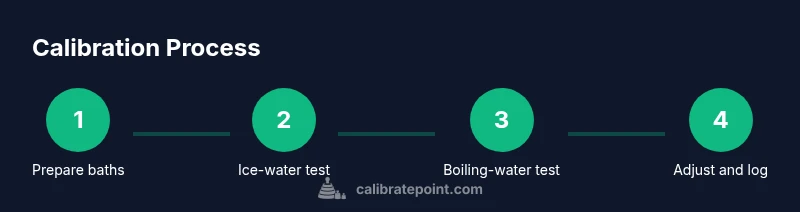
The ice-water test establishes the 32°F baseline, which is essential in any calibration routine. Start by filling a tall, narrow glass with crushed ice and just enough clean water to wet the ice. Stir gently to settle the ice, then insert the thermometer so the sensing area is submerged and remains vertical. Wait 15–30 seconds for the reading to stabilize. A properly functioning thermometer should indicate very close to 32°F. If it reads notably off, note the discrepancy and prepare to adjust or document the offset for future reference. This baseline step reduces guessing and anchors the rest of the calibration process in a known value. For testers, a clear, stable ice bath is the most reliable starting point.
Boiling-water test and altitude considerations
Next, test the thermometer in a rolling boil of water to verify a hot-point reference. Place the thermometer probe into the bubbling water, ensuring it doesn’t touch the pot sides or bottom. Allow the temperature to stabilize, then compare the reading to your expected boiling point. At sea level, water boils around 212°F, but altitude lowers this value. If your readings diverge, adjust if your model allows, or record the offset needed at your altitude. This step confirms the device’s performance at high temperatures, which is especially important for candy stages that occur well above room temperature. Always use heat-resistant gloves and keep hands away from the steam.
Checking for adjustable calibration and how to fix drift
Not all candy thermometers offer an adjustable calibration mechanism. If your unit has a calibration nut or dial, you can loosen the nut slightly, rotate the dial so the reading matches the ice-water baseline, then re-tighten. If there’s no adjustment option, you’ll rely on noting the offset and applying it mentally during cooking, or you may opt to replace the thermometer. After any adjustment, re-test in both ice water and boiling water to confirm the change took effect. Document the final offset and the date of calibration so future batches stay consistent. If drift recurs, frequent recalibration or replacement may be warranted.
Step-by-step procedure: full hands-on calibration
- Clear your workspace and gather all materials.
- Set up an ice-water bath and a boiling-water bath using a deep, stable pot.
- Verify the thermometer reads ~32°F in ice water; note any offset.
- If adjustable, loosen the calibration nut and align the indicator to 32°F, then tighten securely.
- Re-test in ice water to confirm the adjustment.
- Test in boiling water and compare to altitude-adjusted expectation.
- Mark the reference point on the thermometer with tape or a marker for quick checks.
- Record the date, model, and offset in a calibration log.
- Store the thermometer away from extreme heat or cold to avoid bias drift.
- Re-check periodically or after any drop or impact.
Estimated total time: 20–30 minutes.
How to mark and record results for future reference
Keeping a calibration log helps you track accuracy over time and provides a quick reference during busy cooking days. Create a simple table that records (a) thermometer model, (b) date of calibration, (c) ice-water reading, (d) boiling-water reading, (e) altitude, and (f) any offset applied. Attach a small label to the thermometer with the date of the last calibration and the last observed offset. When you buy a new thermometer, run the same test and begin your log afresh. Regular logging reinforces discipline and reduces the chance of using an uncalibrated instrument in critical sugar stages.
Common mistakes and how to avoid them
Common errors include using dirty or wet probes, submerging the sensing area incorrectly, or testing in water that’s not at the proper baseline. Avoid touching the sensing area with your hands, which can transfer oils and skew results. Never place the thermometer in a hot burner flame or direct heat source as this can damage the sensor. Ensure you use clean ice and potable water; impurities affect the ice-water baseline. Finally, don’t rush the stabilization period—allow readings to settle fully before recording numbers. A calm, repeatable process yields the most trustworthy calibration.
Maintenance and storage to preserve accuracy
Maintenance is simple and effective: wipe the thermometer after use, store it away from heat sources, and avoid exposure to rapid temperature swings that can bias readings. Periodically inspect the probe for cracks or corrosion, especially if you use the thermometer near acidic or sugary solutions. If you notice persistent drift after calibration, consider a replacement, as sensors can degrade over time. Keeping the device clean, dry, and properly anchored helps preserve accuracy for many cooking sessions.
Troubleshooting: when to replace rather than recalibrate
If repeated ice-water and boiling-water tests yield inconsistent results or the offset cannot be corrected with any adjustment, the thermometer may be failing. In such cases, replace the unit to maintain reliable results in high-stakes candy making. When replacing, choose a thermometer with a proven calibration mechanism and good user reviews for durability. For safety and accuracy, consider maintaining a spare thermometer for busy days.
Real-world applications: from candy to sugar candy making
Calibrating your candy thermometer is not just about hitting a single temperature—it’s about consistency across batches. When you’re making caramel, fudge, or brittle, precise temperatures ensure the correct texture and yield. With a properly calibrated device, you can confidently move through stages like soft-ball, firm-ball, and hard-crack without guesswork. This reliability extends beyond recipes: professional kitchens rely on accurate thermometers for safety and quality control. By committing to calibration routines, you support predictable results and better outcomes in every sugar project.
Tools & Materials
- Candy thermometer (dial or digital)(Use a clean, dry device of known accuracy)
- Ice-water bath(Crushed ice + water to fill a tall glass)
- Boiling water(Water at a rolling boil; consider altitude)
- Tall glass or small pot(For ice-water bath; narrow helps)
- Marker or tape(To mark calibration offset)
- Timer(To monitor waiting times)
- Tongs or heat-resistant gloves(Handling hot equipment safely)
Steps
Estimated time: 20-30 minutes
- 1
Prepare workspace
Clear the area, assemble baths, and ensure the thermometer is clean and dry before testing.
Tip: Dry probes prevent moisture from skewing the ice-water reading. - 2
Set up ice-water bath
Fill a tall glass with crushed ice and add enough water to just wet the ice; do not submerge any labels or parts beyond the sensing area.
Tip: Let the mixture settle for 1–2 minutes before testing. - 3
Set up boiling-water bath
Boil water in a pot large enough for the thermometer to submerge without touching the sides or bottom.
Tip: Keep the thermometer vertical to avoid bias from contact with the pot area. - 4
Test ice-water reading
Insert the thermometer into the ice-water bath and wait until the reading stabilizes.
Tip: Record the baseline reading and compare to 32°F. - 5
Adjust calibration (if possible)
If your model has a calibration nut, loosen it and gently rotate the dial until the reading shows 32°F in ice water, then re-tighten.
Tip: Do not overtighten; overtightening can damage the mechanism. - 6
Re-test ice-water
Re-insert and confirm the ice-water reading after adjustment.
Tip: A small adjustment is often enough to align the reading. - 7
Test boiling-water reading
Place the thermometer in boiling water and compare to your altitude-adjusted expectation.
Tip: Altitude affects the boiling point; adjust the expected value accordingly. - 8
Mark the calibration offset
If adjustments were made, mark the offset clearly on the device for quick future reference.
Tip: Use durable tape that won’t peel with heat. - 9
Record results in a calibration log
Document date, model, ice-water reading, boiling-water reading, altitude, and the final offset.
Tip: Keep the log in a kitchen notebook or as a digital note for easy access. - 10
Post-calibration checks
After calibration, run a test batch to confirm the device behaves consistently.
Tip: If results vary, repeat tests or consider replacement. - 11
Maintenance and storage
Wipe dry, store away from heat sources, and inspect for wear regularly.
Tip: Avoid exposing the thermometer to rapid temperature swings.
Questions & Answers
Why calibrate a candy thermometer?
Calibration ensures accuracy for sugar stage temperatures and safe, predictable results in candy making.
Calibration ensures your thermometer reads correctly so you hit the right sugar stages every time.
Can I calibrate a digital thermometer the same way?
Yes, use ice-water and boiling-water tests, but check the manual for auto-calibration options when available.
Yes—digital models respond to the same basic tests, but follow the manufacturer’s instructions.
What if my thermometer can’t be adjusted?
If there’s no adjustment mechanism, document the offset and consider replacement or an offset-based approach during cooking.
If you can’t adjust, note the discrepancy and decide whether to replace or compensate during cooking.
How often should I calibrate?
Calibrate after purchase, after any drop, and if you notice inconsistent readings.
Calibrate when you start a new batch or if you suspect drift.
Does altitude affect boiling-point tests?
Yes, higher altitudes lower boiling point; adjust expectations accordingly.
Altitude lowers boiling temperature, so your test temps shift slightly.
Why is 32°F important for candy making?
32°F is the melting point of ice; it’s the baseline for validating the ice-water reading.
32 degrees Fahrenheit is the baseline for ice-water accuracy.
Watch Video
Key Takeaways
- Verify 32°F in ice water as baseline.
- Confirm altitude-adjusted boiling point in boiling water.
- Use calibration nuts or note offset for non-adjustable models.
- Record results for traceability.
- Recalibrate after drops or damage.