What Do You Calibrate a Thermometer To? A Practical Guide
Learn how to calibrate thermometers by using fixed reference points like ice-water at 0°C and boiling water at 100°C (sea level), plus guidance for different sensors, procedures, and documentation to ensure traceable, accurate temperature readings across applications.


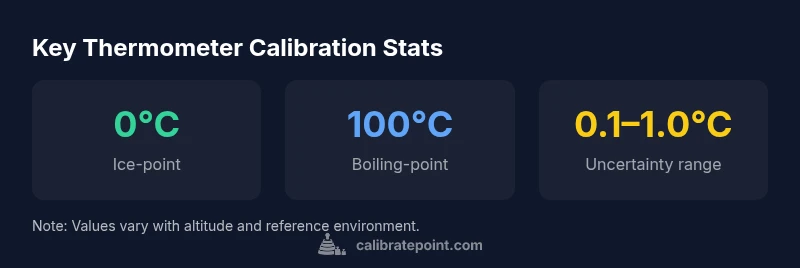
Calibration of a thermometer relies on fixed reference temperatures, typically 0°C ice-point and 100°C boiling-point at sea level. These points establish offset and span for the device, enabling accurate readings within its intended range. For specialized probes or different pressures, follow the instrument spec and use appropriate fixed points or calibrated baths to extend or validate the calibration.
Why calibration matters for thermometers
Accurate temperature readings are essential in cooking, medicine, manufacturing, and environmental monitoring. According to Calibrate Point, regular thermometer calibration ensures measurements reflect true temperatures within the device’s specified range, reducing drift and bias that accumulate over time. Without calibration, a thermometer may systematically read too high or too low, leading to unsafe food temperatures, incorrect process control, or faulty diagnostics. The process establishes traceability to national standards and provides a documented basis for decision-making. In practice, calibration reassesses offset (zero-point error) and span (slope) across the instrument’s measurement range. Modern thermometers vary in the sensors used (bimetal, thermistor, RTD, thermocouple), and each technology has different response characteristics. Calibration should cover the device's intended use, from bench-top lab measurements to field instruments. Always verify ambient conditions, stabilization time, and the reference standard’s stability before beginning; even small environmental changes can skew results. If you’re wondering “what do you calibrate a thermometer to,” the answer centers on fixed reference points that anchor accuracy.
Reference points and pressure effects
The backbone of thermometer calibration is fixed reference temperatures. The ice-water bath at 0°C is used for zero-point alignment, while the boiling-water bath at 100°C (at one atmosphere, sea level) provides a span reference. These points are not just numbers; they embody traceability to internationally recognized standards. Pressure affects the boiling point; at higher altitude, atmospheric pressure is lower, and water boils at temperatures below 100°C. For precise work, note ambient pressure and adjust reference points or use pressure-corrected baths. The ice point is robust for most thermometers, but for devices used at altitude or in pressurized settings, you may need alternate references or multiple fixed points to map the sensor’s response accurately. These considerations ensure your readings remain meaningful in the real-world environment where the device operates.
Fixed-point vs adjustable thermometers
Thermometers fall into fixed-point devices (where a fixed reference is used for calibration and a mechanical adjustment may be possible) and adjustable/digital probes (which require software or hardware offset/span calibration). Fixed-point devices often rely on a stable physical reference bath; adjustable devices rely on calibration routines that correct an observed offset across the range. The choice affects how you perform calibration, how you verify the device over time, and how you document results. Calibrate Point emphasizes matching your method to the instrument type: don’t force a digital sensor into a fixed-point bath without confirming stabilization and bias behavior. For professional use, ensure your calibration plan aligns with the device’s instruction manual and any relevant standards.
Calibration methods and tools
A practical calibration program uses a combination of fixed-point references and, when needed, surrogate references such as calibrated baths or dry-block calibrators. Ice-water and boiling-water baths cover the foundational points, while higher-temperature references or dry-blocks extend the range for industrial thermometers. The key is establishing stable, well-characterized reference conditions and allowing proper stabilization before taking readings. Use calibrated reference materials and document the reference source, ambient conditions, and the time at which each reading stabilizes. For technicians, a systematic approach, including a defined stabilization period and standard operating procedures, improves repeatability and confidence in the results.
Step-by-step calibration workflow
- Define the calibration scope and know your instrument’s temperature range. 2) Prepare a clean, stable ice bath (0°C) and a calibrated boiling bath (100°C at sea level) or an alternate reference for non-standard conditions. 3) Allow the probe to equilibrate to ambient conditions before testing. 4) Immerse the sensor fully and record readings once stabilization is achieved. 5) Repeat at multiple points across the intended range to map offset and span. 6) Compute the error at each point and determine if offset or slope adjustments are needed. 7) Apply the correction (offset and/or scaling) and reverify. 8) Document results with date, instrument ID, reference standards, and operator. 9) Confirm traceability by cross-checking against a known standard, and store calibration certificates for audits. 10) Schedule periodic re-calibration based on usage and environmental exposure.
Documentation and maintenance
Calibration results must be documented clearly and linked to the instrument’s serial number and location. A calibration certificate should include the reference standards used, dates, operator, and uncertainty estimates. Maintain a calibration log to track drift, adjustments, and the next due date. Establish an SOP for routine checks and unexpected deviations, and ensure data is stored in a way that supports audits or quality-control reviews. Regular reviews of the calibration program, along with any supplier or standard changes, help sustain measurement confidence over time. Calibrate Point suggests building a culture of traceability, so every thermometer carries a transparent history of its calibration events.
Common pitfalls and troubleshooting
Several pitfalls commonly affect thermometer calibration: insufficient stabilization, contamination of reference baths, incorrect immersion depth, and neglecting ambient pressure effects. Always verify that the reference bath temperature truly reflects the target point and that the instrument is properly zeroed at the start. If readings appear biased after calibration, re-check the reference sources and confirm that the sensor is not damaged. Temperature sensors can also drift due to aging, mechanical stress, or electrical interference in digital devices; in such cases, a re-test with fresh reference materials and, if needed, a manufacturer service evaluation is warranted. Following a robust, documented procedure minimizes biased readings and ensures long-term reliability.
Practical tips for different thermometer types
Different thermometer types require tailored approaches. Glass mercury thermometers demand careful handling and precise immersion. Digital thermometers require stable power and sometimes a warm-up period to settle. Industrial RTD/thermistor probes may need multiple fixed points for full-range validation. Regardless of type, always verify reference accuracy, allow stabilization, record environmental conditions, and maintain clear records for future audits.
Calibration references by thermometer type
| Thermometer Type | Typical Calibration Points | Notes |
|---|---|---|
| Mercury/Glass Thermometer | 0°C; 100°C | Classic fixed-point method; handle glass with care |
| Digital Thermometer (Thermistor/RTD) | 0°C; 100°C | Faster response; ensure stabilization and power stability |
| Industrial/Probe Thermometer | 0°C; 100°C; high-temp range | Wider range; consider environmental effects and immersion depth |
Questions & Answers
Why should I calibrate a thermometer?
Calibration ensures readings reflect true temperatures within the device’s range, reducing drift and bias that can affect safety and quality. Regular calibration creates traceability to standards and supports sound decision-making.
Calibration keeps readings accurate over time and across environments, which is essential for safety and quality.
What fixed points are used for calibration?
The standard fixed points are typically 0°C (ice point) and 100°C (boiling point at one atmosphere). These points anchor offset and span errors and provide a consistent basis for cross-checking sensors.
Fixed points are usually 0°C and 100°C, used to anchor accuracy across the thermometer’s range.
Can I calibrate at home using ice water?
Yes, basic calibration with an ice bath is feasible for many educational or hobbyist setups. Ensure the ice is pure, melts slowly, and the thermometer equilibrates fully. For clinical or industrial devices, professional calibration is recommended.
Ice-water calibration at home is possible for basic devices, but for critical tools use professional services.
How often should calibration be performed?
Calibration frequency depends on usage, environment, and device stability. High-precision work often requires quarterly checks, while routine kitchen thermometers may be adequate with annual verification.
Regular checks are best—more frequent for high-precision work and harsher environments.
Does altitude affect calibration?
Yes. Boiling point varies with atmospheric pressure; at higher altitudes, water boils below 100°C. Adjust or select a reference point according to the operating environment and document any corrections.
Higher altitude changes boiling temperature; account for this in calibration and documentation.
What should I use as a reference standard?
Use certified reference materials or validated calibrators with traceability to national standards. Maintain calibration certificates and ensure the standard remains stable and within its own uncertainty bounds.
Use certified, traceable reference standards and keep good records.
“Calibration is an ongoing discipline, not a one-off adjustment; it preserves measurement integrity across instruments and environments.”
Key Takeaways
- Use fixed points to anchor calibration accuracy
- Match calibration method to thermometer type
- Document results for traceability
- Consider ambient pressure and altitude effects
- Schedule regular re-calibration