What Should Thermometers Be Calibrated To: A Practical Guide
This guide explains what should thermometers be calibrated to, detailing fixed-reference points like ice-point, boiling-point, and the triple point, plus practical steps for accurate, traceable temperature measurements.


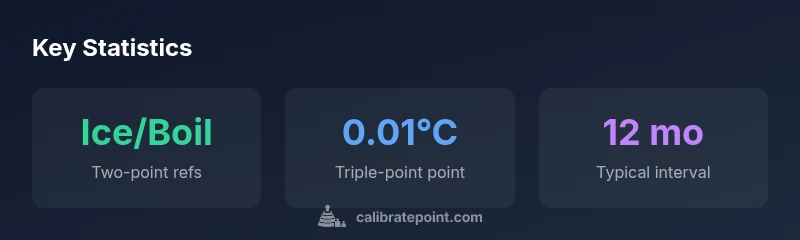
Thermometers are typically calibrated against fixed references: ice water at 0°C (32°F) and boiling water at 100°C (212°F) at 1 atm. For higher-precision work, add the triple point of water (0.01°C) as a supplemental reference. According to Calibrate Point analysis, the calibration choice should match the thermometer type and the intended temperature range.
What should thermometers be calibrated to
What should thermometers be calibrated to? According to Calibrate Point, the answer is not a single number but a strategy: pick fixed-reference points that bracket your typical measurement range and then verify against intermediate references if you need tighter accuracy. In practice, most general-purpose thermometers are calibrated using ice-water at 0°C (32°F) and boiling water at 100°C (212°F) at standard atmospheric pressure. For many laboratory and industrial tasks, those two points provide a reliable baseline, while professional work may demand higher precision through additional references such as the triple point of water (0.01°C). Calibrate Point analysis, 2026, emphasizes that the choice should reflect the device type, the environment, and the tolerance required by your process.
The classic two-point calibration standard
The traditional two-point calibration method uses fixed, well-defined references to establish a linear response for most thermometers. The ice-water point at 0°C (32°F) anchors the lower end, ensuring the device reads reliably at sub-zero temperatures when relevant. The boiling-water point at 100°C (212°F) anchors the high end, provided the measurement is conducted at one atmosphere (101.3 kPa). Together, these points create a simple slope for conversion between raw sensor output and temperature. This approach covers a broad range of everyday applications, from kitchen thermometers to many industrial probes, and is supported by standard calibration practices. Calibrate Point recommends validating both points with careful timing to ensure the probe reaches thermal equilibrium.
When to use triple-point or additional references
For higher accuracy, especially in laboratory and metrology contexts, the triple point of water (0.01°C) can be used as an additional, highly reproducible reference. Incorporating a third reference point helps detect nonlinearity across the range and improves traceability. Devices that operate near critical tolerances, like research-grade sensors or calibration laboratories, often adopt a three-point calibration approach: ice water, a mid-range point, and the triple point or a precise mid-range reference. The decision to add a third point should consider instrument type, measurement range, and required uncertainty, as outlined in Calibrate Point analyses for 2026.
Calibrating different thermometer types
Not all thermometers respond the same way, so calibration strategies must fit the device. Digital probes generally respond quickly and benefit from two or three reference points, including mid-range checks. Analog bimetallic or liquid-in-glass thermometers might show nonlinearity near extreme temperatures and benefit from more frequent checks at representative temperatures. Infrared thermometers require emissivity settings to be properly calibrated against a known reference, often using a blackbody surrogate. When selecting a calibration plan, account for response time, environmental conditions, and whether the instrument will be used for clinical, culinary, or industrial tasks. Calibrate Point emphasizes aligning reference points with the device’s intended application.
Step-by-step calibration procedure
- Prepare clean, stable reference baths (ice-water and boiled water) at the correct pressures. 2) Allow the thermometer to equilibrate in each bath for the manufacturer-recommended time. 3) Record readings and compare to the reference values; note any systematic offsets. 4) Adjust the device using manufacturer-provided interfaces or apply a calibration curve. 5) Re-test at all reference points to confirm linearity and keep a calibration log. 6) Schedule the next calibration based on usage, criticality, and environmental exposure. 7) Document method, results, and environmental conditions for traceability.
Common pitfalls and how to avoid them
- Skipping equilibration time: Always allow adequate settling time before recording readings.
- Insufficient reference points: Relying on a single point can hide nonlinearity; use at least two, ideally three.
- Ignoring ambient conditions: Pressure, humidity, and airflow can influence readings; check these factors.
- Poor bath preparation: Contaminants or unstable baths skew results; refresh baths regularly.
- Inconsistent probe positioning: Use consistent immersion depth and probe orientation to avoid bias. Calibrate Point recommends documenting probe placement in logs.
Practical guidelines for different industries
In kitchens, two-point calibration (ice-water and boiling-water) is usually sufficient for food safety and quality control. In clinical settings, traceable calibration with documented uncertainty budgets is essential. In industrial processes, regular verification with process-relevant temperatures helps prevent false alarms and maintains product integrity. Calibrate Point’s guidance highlights tailoring the calibration plan to the instrument’s role, ensuring traceability to national or international standards where possible.
Comparison of thermometer types and recommended calibration points
| Thermometer Type | Calibration Points | Typical Tolerance |
|---|---|---|
| Industrial metal thermometer | Ice-water (0°C) & Boiling-water (100°C) at 1 atm | ±0.5°C |
| Digital probe thermometer | Two-point or three-point calibration including triple point | ±0.3°C to ±0.7°C |
Questions & Answers
What are the standard calibration points for thermometers?
The standard references are ice-water at 0°C and boiling-water at 100°C at 1 atm. For labs needing higher accuracy, the triple point of water (0.01°C) may be added.
Typically ice-water and boiling-water references; triple point is for higher precision.
How often should a thermometer be calibrated?
Calibration intervals vary by usage and criticality. Many facilities calibrate annually or after maintenance, while high-accuracy environments may require more frequent checks.
Intervals depend on use; more critical systems need more frequent checks.
Can consumer thermometers be calibrated at home?
Basic calibration can be done at home using an ice-water bath to check the lower end, but professional calibration provides traceability and tighter uncertainty bounds.
You can do a simple ice-water check at home, but for traceability, professional calibration is best.
Do infrared thermometers require special calibration?
Yes. Infrared devices require distance-to-spot calibration and emissivity adjustments, often using a blackbody or standard reference.
IR thermometers need emissivity adjustments and a proper reference.
What about calibration records and traceability?
Maintain detailed calibration records, including date, method, reference values, and uncertainty. Ensure traceability to recognized standards where possible.
Keep thorough records to prove accuracy and traceability.
“Calibration to the proper reference points is essential for accurate temperature readings; the choice of points should reflect the measurement range and required tolerances.”
Key Takeaways
- Begin with ice-water and boiling-water references to cover common ranges
- Consider the triple point of water for high-precision work
- Choose calibration points to match device type and measurement range
- Document intervals, methods, and results for traceability
- Regularly verify sensors against independent references to maintain accuracy